Binh Phuoc Province Industrial Parks Attract Investment
General Overview
Binh Phuoc is a border province in the Southeastern region of Vietnam. It was re-established in 1997 after being separated from the former Song Be Province. It is the largest province in Southern Vietnam by area.
Binh Phuoc lies within the Southern Key Economic Region and shares a border with the Kingdom of Cambodia, adjoining three Cambodian provinces: Tbong Khmum, Kratie, and Mondulkiri. The province serves as both a gateway and a bridge connecting the Southeast region with the Central Highlands and Cambodia. It has a total borderline length of 258.939 km with 28 main and 353 auxiliary border markers.
Currently, Binh Phuoc manages four border gates (Hoa Lu International Border Gate, Hoang Dieu Main Border Gate, Loc Thinh Border Gate, Tan Tien Auxiliary Border Gate) and one open crossing.
As a transshipment hub between the South Central Highlands and the Southeastern region, Binh Phuoc features diverse topography — including highlands, hills, and plains. It is also the source of many rivers and streams, with a dense river network (0.7–0.8 km/km²). The main rivers include the Be River, Dong Nai River, and Saigon River — all part of the Dong Nai river system.
Strengths of the Province
The province’s strengths lie in industrial crops such as cashew, pepper, rubber, and cocoa, with a total perennial crop area of about 391,174 ha. Cashew and rubber remain national leading crops.
Binh Phuoc has become an ideal destination and attractive investment environment for both domestic and foreign investors, thanks to open, preferential, and transparent policies. The province boasts abundant natural resources, a vast reserve of clean land, convenient transportation, and low labor costs. As the center of industrial and agricultural production in the region, it continues to draw strong investment interest.
The Party Committee and people of Binh Phuoc always provide the most favorable conditions for investors. Along with infrastructure development, the province focuses on administrative reform, improving the business climate, and flexibly applying national policies to local realities.
Key priorities include:
Developing education and vocational training to build a skilled workforce.
Promoting talent attraction and partnerships in human resource development.
Encouraging technological innovation and business growth.
Creating jobs and increasing economic productivity.
Geographic Location
Binh Phuoc has a total natural area of 6,873.56 km² and is bordered by:
- North: Dak Nong Province
- South: Binh Duong Province
- East: Lam Dong and Dong Nai Provinces
- West: Tay Ninh Province
- Northwest: Cambodia
Administrative Units
Binh Phuoc consists of 11 district-level administrative units with 111 communes, wards, and townships:
1 city: Dong Xoai
3 towns: Phuoc Long, Binh Long, Chon Thanh
7 districts: Dong Phu, Bu Dang, Bu Dop, Bu Gia Map, Loc Ninh, Hon Quan, Phu Rieng
Population and Labor
The province is home to 41 ethnic groups. As of the end of 2022, the population was approximately 1,034,667 people. The labor force was estimated at 604,976 people, an increase of 0.26% compared to 2021. Among them, 281,320 were female and 151,214 lived in urban areas.
The employment structure continues to shift from agriculture to industry, construction, and services. Working-age employment reached 97.99% of the labor force. The largest ethnic minority group is the Stieng people.
The two major religions are Buddhism and Catholicism, followed by Protestantism (mainly in Phuoc Long, Binh Long, Bu Dang) and Cao Dai (Binh Long, Phuoc Long, Loc Ninh).
Education
Binh Phuoc has focused on expanding and modernizing its education system to ensure equitable access and quality improvement. The province currently has 430 schools (388 public, 42 private) serving over 247,000 students.
Facilities include:
7,791 classrooms
1,008 subject rooms
800 learning-support rooms
601 functional rooms
The education sector still lacks about 1,500 teachers. Efforts are being made to standardize, modernize, and promote social investment in education.
In vocational training, by 2025, the province targets:
40–45% of secondary and high school graduates entering vocational programs.
10% of the workforce receiving retraining or continuous education.
30% of workers having certificates or diplomas.
Binh Phuoc currently has 3 colleges and 2 secondary schools, with plans to upgrade:
Binh Phuoc Pedagogical College → Binh Phuoc University.
Binh Phuoc Medical Secondary School → Binh Phuoc Medical College.
Transport Infrastructure
Developing regional connectivity is one of the province’s top priorities to attract investment and stimulate economic growth.
Between 2016–2020, Binh Phuoc invested heavily in upgrading thousands of kilometers of roads, including key routes such as National Highways 13, 14, DT741, and DT759.
The province now has a well-paved network connecting districts and communes — with 108 out of 111 communes having asphalted roads to their centers, ensuring smooth travel year-round.
This comprehensive infrastructure system has positioned Binh Phuoc as an appealing destination for investors.
Railways
In the master plan, the Trans-Asian Railway (Saigon–Loc Ninh), a 114 km section crossing Binh Phuoc, will connect 28 countries. It is part of an ASEAN initiative to boost regional trade, tourism, and economic cooperation. The line will also connect to Dak Nong to facilitate transport of minerals and agricultural-forestry products to southern seaports.
Roads
As of 2021, Binh Phuoc has:
3 national highways (No. 13, 14, 14C)
15 provincial roads
325 urban routes
2,135 communal roads
241 specialized and border patrol roads
Total road length: 9,102 km, with 64.17% asphalted.
The Prime Minister approved the HCMC–Chon Thanh Expressway section in 2021, currently under coordination with HCMC and Binh Duong for implementation.
Period 2020–2025
During this period, the Trans-Asian Railway will extend through Hoa Lu Border Gate, linking Ho Chi Minh City and the Mekong Delta to Cambodia, Laos, Myanmar, Malaysia, and Thailand — greatly enhancing regional trade.
The Prime Minister has also approved three new national highways: QL13B, QL13C, and QL55B (Binh Phuoc–Cat Tien–Lam Dong).
The province is coordinating the development of:
Gia Nghia (Dak Nong) – Chon Thanh Expressway
HCMC – Thu Dau Mot – Chon Thanh Expressway
Ho Chi Minh Road
DT753 route connecting to Long Thanh International Airport and Cai Mep–Thi Vai Port.
Inland Ports
Binh Phuoc has three major rivers (Be, Dong Nai, Saigon) but has not yet fully utilized them for freight or passenger transport.
While the province has the Hoa Lu International Border Gate and several industrial parks, it lacks seaports. However, it has two inland container depots (ICDs) — one in Minh Hung Industrial Park (Chon Thanh) and another at Hoa Lu Border Gate, currently under construction.
A third ICD is being planned in Nam Dong Phu–Bac Dong Phu Industrial Park, forming a logistics network to support future industrial and service growth.
Economic Performance in 2022
Located near Ho Chi Minh City and bordering Cambodia, Binh Phuoc enjoys numerous development opportunities.
Key 2022 results include:
Economic growth: 9.1% (target: 7–7.5%)
Agriculture–forestry–fishery: +2.66%
Industry–construction: +16.24% (manufacturing alone +18.7%)
Services: +8.73%
Per capita GRDP: VND 85.1 million (~USD 3,550) (+11.6%)
Budget revenue: VND 14,535 billion, 119% of the Ministry of Finance’s plan (+6%)
Economic structure (2022):
Agriculture–forestry–fishery: 21.46%
Industry–construction: 43.19%
Services: 31.43%
Product tax minus subsidies: 3.92%
Industrial Growth Highlights
Industrial production index: +20.05% YoY.
Manufacturing–processing industry: +21.17%.
Electricity generation & distribution: +8.15%.
Water supply and waste treatment: +11.86%.
Mining: -8.69%.
Labor in industrial enterprises increased by 4.37%.
State-owned: +1.58%
Private: -48.72%
FDI enterprises: +29.26%
Exports reached USD 3.85 billion (+10%), meeting annual targets.
Retail sales and services totaled VND 65,067 billion (+35.76%).
Investment capital reached VND 31,433 billion (+17.79%), equal to 36.17% of GRDP.
Industrial Development
Although industrial real estate in Binh Phuoc has developed more slowly than in HCMC, Long An, Binh Duong, or Dong Nai, its capital costs are much lower, and regional connectivity is comparable — thanks to ongoing upgrades to major routes like National Highways 13 & 14 and the My Phuoc–Tan Van Expressway.
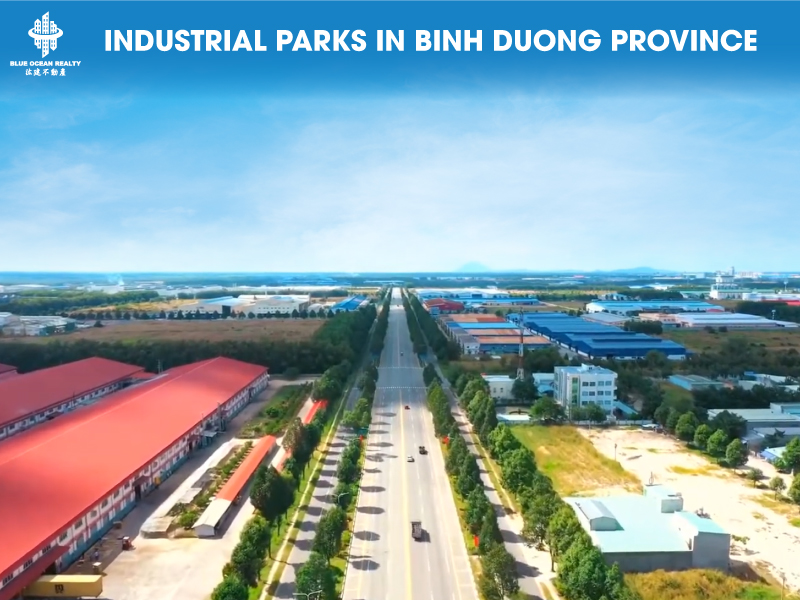
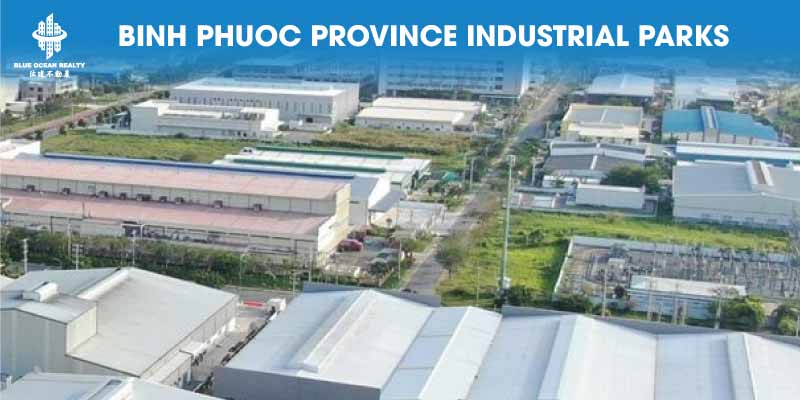
The province has 13 industrial parks (4,686 ha) and 8 industrial clusters (380 ha). Among them, 11 industrial parks are fully operational with an average occupancy rate of 81.66%, and 7 parks have reached 100% occupancy.
Enhancing Industrial and Regional Connectivity
Industrial parks are concentrated in Chon Thanh, Hon Quan, Dong Phu, and Dong Xoai.
The Hoa Lu International Border Gate Economic Zone, covering over 28,364 ha, borders Cambodia and offers excellent transport connections to Laos and Thailand. The central area (3,535.17 ha) is already operational, with many other clusters approved or planned along major routes linking Binh Phuoc to Binh Duong and Ho Chi Minh City.
Binh Phuoc serves as a strategic link between the Central Highlands, the Southwest region, and the Southern Key Economic Zone, where Ho Chi Minh City acts as the nucleus.
In the coming years, the province aims to:
Continue expanding industrial development to form a regional industrial corridor.
Restructure agriculture toward high-tech production and value chain integration.
Accelerate transport infrastructure projects to strengthen regional linkages.
Promote industrial zoning along transport routes and develop supporting service networks for the region and Ho Chi Minh City.
Learn more about us:
—
Your trusted partner in Vietnam Real Estate, Industrial Parks, and Invest Vietnam.
Stay Connected:
- Fanpage: blueoceanrealtyvn
- Youtube: BlueOceanRealty , @batdongsanbor , @blueoceanrealtyvietnam
- Instagram: blueoceanrealtyvn
- Tiktok: @bortintuc
Hotline/ Zalo: +84888089696
—