Lang Son Province Industrial Parks And Investment Attraction
Lang Son is one of the provinces with a proud history of development among the 63 provinces and cities in the country. Since the earliest Vietnamese state of Văn Lang, Lang Son belonged to the Lục Hải region. During the Lý Dynasty, when the administrative system was organized into roads (lộ), prefectures (phủ), and districts (châu), the land of Lang Son was mainly part of Lạng Châu.
During the period of economic and social restructuring under Đổi Mới (Reform), Lang Son made positive transitions, gradually exploiting its potentials and advantages effectively. In the 2015–2020 period: the GRDP per capita by 2020 reached 44.5 million VND (1.44 times that of 2015); out of 181 communes, 65 achieved new rural standards; nearly 3,000 enterprises across the country regularly participated in import-export activities in the province; annual average export turnover increased by 6.1%; the share of paved roads to commune centers reached 82%; forest coverage rate reached 63%; the urban and rural landscape improved markedly. Foreign relations were expanded and deepened, and the province’s capacity for international integration was enhanced.
Beyond natural conditions, abundant natural resources, and rich human-cultural values, Lang Son also has a favorable transportation network. Its border runs 253 km with China; it has 2 international gates (Hữu Nghị road border gate and Đồng Đăng rail border gate), 2 national border gates (Chi Ma, Bình Nghi), and 7 paired border markets, making Lang Son an important center of commerce between Vietnam and China, and further to Central Asia and Europe. Especially under the national policy to invest in border economic zones, Lang Son has strong conditions to develop sectors such as trade, tourism, and services. The border-gate economic zone is among the province’s priority economic spheres, playing a dynamic role in promoting socio-economic growth and structural transformation.
Situated in the border region, Lang Son is not only an economic gateway but also land possessing strong industrial potential. The policy to diversify and expand industrial development is a top priority; the Provincial People’s Committee has promulgated many preferential policies aimed at making industry a core economic sector.
Lang Son holds advantages in commercial economy development through border economic zones, a favorable transport network, and vibrant cross-border trade. Goods in the province and neighboring provinces pass through Lang Son in large volumes, variety, and with year-on-year growth. Each year, hundreds of enterprises nationwide engage in export via the border, attracting domestic and foreign investors into trade, service, tourism, and industrial sectors. The rapid development of commerce in Lang Son has contributed to industrial growth, raised incomes, and increased state budget revenue. Every year, tax revenues from trade activity account for over 80% of the province’s total budget.
The province has over 231 km of border, 2 international border gates (Hữu Nghị and Đồng Đăng), 1 main gate, and 9 auxiliary gates, along with a convenient transportation network. Lang Son is a major transit gateway for goods between Vietnam and ASEAN into China and vice versa.
In recent years, Lang Son has achieved important results in socio-economic development. Its economy has grown steadily, with economic structure shifting appropriately—reducing the share of agriculture while increasing industry and services.
Geographical Position
- North: borders Cao Bằng Province
- East: borders Quảng Ninh Province and Sùng Tả city (Guangxi, China)
- South: borders Bắc Giang Province
- West: borders Bắc Kạn and Thái Nguyên Provinces
Administrative Units
By 2022, Lang Son has 11 administrative units:
1 city: Lang Son
10 districts: Bắc Sơn, Bình Gia, Cao Lộc, Chi Lăng, Đình Lập, Hữu Lũng, Lộc Bình, Tràng Định, Văn Lãng, Văn Quan
Population
Natural area: 8,310.2 km²; population approx. 781,655 (2019), ranking 52nd in population.
Urban population: 159,670 (20.4%); rural: 621,985 (79.6%).
Ethnic composition: 84.74% are ethnic minority groups. Among them, Nùng (43.9%), Tày (35.3%), Kinh (15.3%), Dao (3.5%), and Hoa, Sán Chay, Mông and others ~1.4%.
Healthcare
210/226 communes, wards, and towns meet national health standards (92.9%). Hospital bed ratio: 22.16 beds per 10,000 people; 8.4 physicians per 10,000 people.
Education
Lang Son has developed an education and training system from preschool to high school, distance learning, vocational education, boarding schools for ethnic minority areas, with public, private, and non-public institutions.
Tourism
… (text omitted as it was marked with ellipsis)
Transportation Infrastructure
Lang Son lies along key national routes: Highways 1A, 1B, 4A, 4B, 279. It is a strategic node linking western provinces (Cao Bằng, Thái Nguyên, Bắc Kạn), eastern provinces (Quảng Ninh), southern provinces (Bắc Giang, Bắc Ninh, and Hanoi), and northern China. It also has international railway linkage, strengthening economic, scientific, and technological exchange with southern provinces, China, and further into Central Asia and Europe.
Road Network
The province has 2,828 km of roads, density of 0.35 km per km², including national highways:
- Highway 1A (Lạng Sơn – Hanoi, 154 km)
- Highway 1B (Đồng Đăng – Thái Nguyên, 105 km)
- Highway 4A (Lạng Sơn – Cao Bằng, 66 km)
- Highway 4B (Lạng Sơn – Quảng Ninh, 80 km)
- Highway 31 (Đình Lập – Bắc Giang, 61 km)
- Highway 279 (Bình Gia – Thái Nguyên, 55 km)
Provincial roads: ~1,350 km
District roads: ~974 km
Roads reach all district centers, border gates, border markets, and all 226 commune-level subdivisions.
Railway
The international railway line from Hanoi to Đồng Đăng – Lạng Sơn connects with China, spanning 165 km; the Lao Cai section is highly leveraged for freight and passenger transport.
Water Transport
Certain sections of the Kỳ Cùng River—from Lộc Bình through the city to Văn Lãng and Tràng Định—serve as minor waterways.
Economy in 2021
In 2021, despite COVID-19 difficulties, Lang Son achieved 6.67% GRDP growth (below target 7–7.5%), where:
Agriculture increased 5.86%
Industry-construction increased 9.31%
Services increased 5.66%
Tax revenue (excluding subsidies) increased 7.41%.
Economic structure:
Agriculture: 22.14%
Industry-construction: 23.21%
Services: 49.95%
Net product taxes: 4.7%
Per capita GRDP: 46.9 million VND.
In 2021, 10 more communes achieved new rural standards, 5 communes achieved advanced rural standards. On average, each commune achieved 13.5–14 criteria. Each district produced 2–3 model residential clusters.
Total registered new enterprises: 416 (83.26% of plan), combined capital: 3,890 billion VND. The cumulative number of enterprises: 3,312 with total registered capital of 30,584 billion VND.
State budget revenue in 2021 reached a record high: 10,649.6 billion VND, achieving 182.5% of the plan and rising 48% over the prior year. Local public expenditure was strictly controlled.
Industrial Development
In 2021, industrial production in Lang Son maintained growth compared to 2020. However, most projects remain small-scale, with limited technological innovation.
In 2022, the industrial–construction sector, particularly infrastructure, was predicted to achieve high growth. New major projects began: Bắc Giang – Lạng Sơn expressway (Hữu Nghị – Chi Lăng), Mẫu Sơn tourism zone, upgrade of Highway 4B (Km18 to Km80), etc. Despite the pandemic, many investors surveyed and proposed new projects in 2021, leading to potential new large-scale projects in 2022.
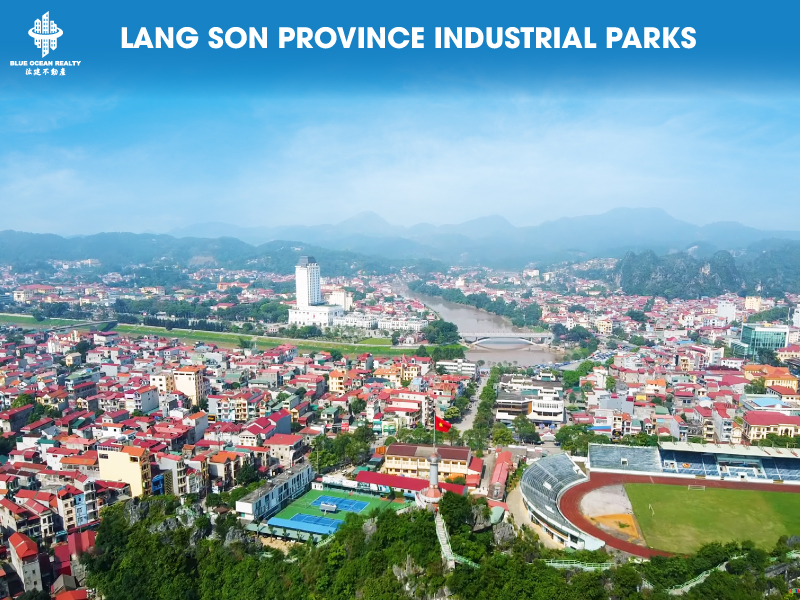
Lang Son is stepping up development of industrial zones and clusters. The province currently plans 2 industrial parks totaling ~762 ha: Dong Banh IP (162 ha) and Huu Lung IP (599.76 ha). Also planned: Hong Phong IP (440 ha), within the Dong Dang – Lang Son border economic zone, plus 16 industrial clusters. These are core growth fields for industrial exports, employment generation, improving local living standards, and contributing to poverty reduction.
From 2021 to 2025, the province aims by 2030:
Industry’s share of GRDP: 10–11%
Processing/manufacturing: 5–6%
Mining: ~2%
Power, water utilities: 3–4%
Industrial growth rate: >9% annually
In 2022, Lang Son’s Department of Industry & Trade sets target: industrial output value increases by 7–8% over 2021. The province plans to form 10 industrial clusters, focusing large-scale clusters in Huu Lung, Cao Loc, Loc Binh districts to evolve into concentrated industrial zones in the future.
Learn more about us:
—
Your trusted partner in Vietnam Real Estate, Industrial Parks, and Invest Vietnam.
Stay Connected:
- Fanpage: blueoceanrealtyvn
- Youtube: BlueOceanRealty , @batdongsanbor , @blueoceanrealtyvietnam
- Instagram: blueoceanrealtyvn
- Tiktok: @bortintuc
Hotline/ Zalo: +84888089696
—