Industrial Parks in Binh Duong Province Attract Investment
Binh Duong has long been known for its vibrant commercial activities and its role as a convergence point for people from regions across the country. During the French colonial period, Binh Duong was known as an agricultural “garden province,” with only two main transportation routes: the Saigon River and National Highway 13. The population was only a few tens of thousands, mostly farmers. At that time, few could have imagined that Binh Duong would rise to become one of Vietnam’s leading industrial provinces, as it is today. Binh Duong also has the highest urbanization rate in the country, reaching 84.32% as of 2023.
Beyond its dynamic economic development, Binh Duong is known for its rich and diverse historical and cultural heritage, blending Southern cultural characteristics while retaining its own unique identity. To date, the province has 11 nationally recognized historical and cultural relics, and 39 relics recognized at the provincial level. Over its 300-year history, Binh Duong has built a deep cultural imprint through traditional craft villages, producing sophisticated handicraft products that have been well-known for centuries.
Binh Duong has been successful in developing industrial parks and has been designated by the Government as one of the core localities of the Southern Key Economic Region. Additionally, Binh Duong is an official member of the Intelligent Community Forum (ICF), the World Technopolis Association (WTA), and the World Trade Centers Association (WTCA). The province has been recognized for three consecutive years as one of the top 21 regions worldwide with exemplary smart city development strategies. Its rapid growth is supported by one of the most advanced transportation infrastructure systems in Vietnam.
With more than 300 years of history, the land and people of Binh Duong have created and continue to create a strong impression on international partners. These achievements are driven not only by a dynamic economy and an open investment environment but also by the craftsmanship and creativity of Binh Duong’s people, whose refined handicraft products convey meaningful cultural messages to the world.
Geographical Location
Binh Duong Province is located in the Southeast region and belongs to the Southern Key Economic Region. The province covers an area of 2,694.4 km² (0.83% of Vietnam’s total area and 12% of the Southeast region), ranking fourth in the region. Geographic coordinates: 10°51’46″N – 11°30’N, 106°20’E – 106°58’E.
East: borders Dong Nai Province
North: borders Binh Phuoc Province
West: borders Tay Ninh Province and part of Ho Chi Minh City
South: borders Ho Chi Minh City and part of Dong Nai Province
Administrative Units
Binh Duong has 9 district-level administrative units, including 1 city, 4 towns, and 4 districts, with a total of 91 commune-level units (48 communes, 41 wards, and 2 townships).
1 city: Thu Dau Mot City
4 towns: Di An, Thuan An, Ben Cat, Tan Uyen
4 districts: Bau Bang, Bac Tan Uyen, Dau Tieng, Phu Giao
Population
The average population of Binh Duong in 2021 was 2,685,513 people, an increase of 104,963 people (4.07%) compared to 2020.
Urban population: 2,266,771 (84.4%)
Rural population: 418,742 (15.6%)
Male: 1,373,424 (51.1%)
Female: 1,312,089 (48.9%)
Population density: 997 people/km²
Approximately 15 ethnic groups reside in the province, the majority being Kinh, followed by Chinese, Khmer, and others. The province has 13 religions with 186,021 followers, including Catholicism (108,260), Buddhism (58,220), Hoa Hao Buddhism (10,619), Caodaism (5,962), Protestantism (1,962), Islam (745), among others.
Each year, the province allocates substantial budget resources to build modern educational infrastructure and encourages socialization policies to attract private investment in standardized, modern schools.
Education
Recognizing that education investment is essential for long-term sustainable development, Binh Duong has adopted strategic measures to fundamentally and comprehensively reform education and training. With strong socio-economic development attracting large numbers of workers from other provinces, student enrollment increases by around 32,000 students annually.
The province currently has:
455 preschools, 266 general education schools
8 universities, 7 colleges, 16 vocational schools, 46 training centers, and 50 foreign language and IT centers
These institutions train approximately 80,000–85,000 learners annually, supplying essential human resources for local development.
Transportation Infrastructure
Binh Duong covers 2,694.4 km² and is part of the Southern Key Economic Region, with one of the most extensive transportation systems in Vietnam. The province has around 7,300 km of roads, including 77.1 km of national highways and 500 km of provincial roads.
Binh Duong is focusing on synchronous infrastructure development and diversifying investment sources to enhance interregional connectivity. As a result, the province remains highly attractive to investors.
Railways
Binh Duong has two stations on the North–South railway: Song Than Station and Di An Station. Since June 2019, Di An Station officially replaced Song Than Station for passenger services.
Roads
Key arterial roads include:
Belt Road 3
Belt Road 4
My Phuoc – Tan Van Boulevard
Binh Duong Boulevard
Ho Chi Minh Road
Hoi Nghia – An Tay Road
National Highway 13, the province’s economic backbone, will be expanded to enhance regional connectivity.
My Phuoc – Tan Van Road runs 64 km and links major industrial parks, significantly reducing congestion on National Highway 13.
Belt Road 4, approved in 2013 with an investment of over VND 98 trillion, connects five major southern provinces: Ba Ria–Vung Tau, Dong Nai, Binh Duong, Ho Chi Minh City, and Long An.
Aviation
Binh Duong is 10–15 km from Tan Son Nhat International Airport. Plans for two additional airports in Ben Cat and Dau Tieng have been proposed for future demand.
Waterways
The province is bordered by three major rivers, especially the Saigon River (256 km), supporting logistics and trade flows to southern ports and the Mekong Delta.
Economic Development in 2022
Despite global challenges, Binh Duong achieved breakthrough results in 2022.
Key highlights:
- Second-highest FDI attraction in Vietnam
- Domestic investment: VND 96,722 billion (~USD 4 billion), up 28.1%
- FDI attraction: USD 2.841 billion
- Cumulative totals:
- 59,105 domestic enterprises with VND 608 trillion capital
- 4,076 FDI projects with USD 39.67 billion capital
- Other 2022 indicators:
- GRDP growth: 8.29%
- Retail + service revenue: up 16.8%
- Total social investment: up 12.9%
- GRDP per capita: VND 169.8 million
- Industrial production index: up 8.9%
- Export value: USD 35.7 billion (+9%)
- Import value: USD 25.8 billion
- Trade surplus: USD 9.2 billion, accounting for 80% of Vietnam’s total surplus
Economic Targets for 2023
Binh Duong set 35 key targets, including:
GRDP growth: 8.5–8.7%
Industrial production index: +8.9%
Budget revenue: over VND 74,000 billion
The province continues prioritizing technology-based industries, service sectors with high added value, and expanding export markets to India and South America.
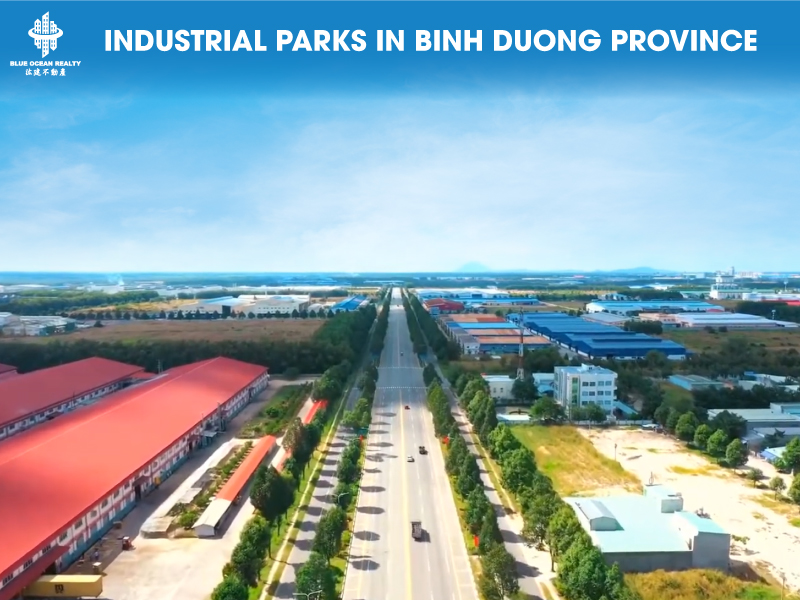
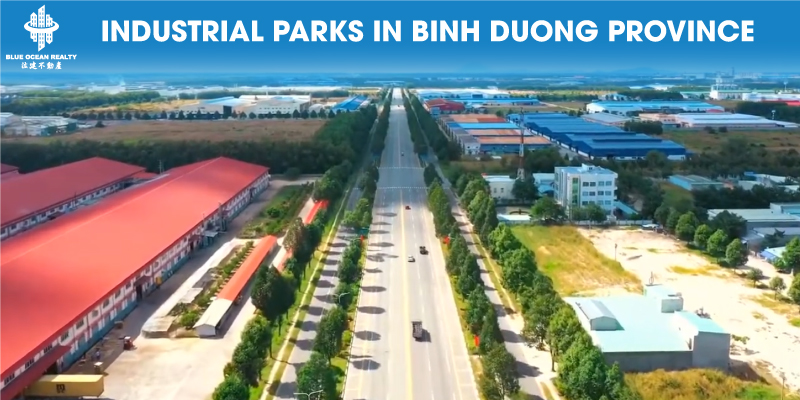
Industrial Parks in Binh Duong Province
Binh Duong has transformed vast agricultural lands into some of Vietnam’s most important industrial zones. The first industrial park, Song Than 1, was established in 1995 with 178.01 ha.
To date:
- 34 industrial parks approved, total planned area 14,790 ha
- 29 industrial parks established, with 12,662 ha
- 27 parks operational, with 10,962 ha, occupancy rate 87.4%
- Typical industrial parks with world-class infrastructure include:
- VSIP 1, VSIP 2
- My Phuoc Complex
- Dong An IP
- Binh Duong accounts for 1/4 of the Southern region’s industrial park area, ranking top nationwide in industrial production and FDI attraction.
- Investors come from 53 countries and territories.
2016–2020 output from industrial parks: - Revenue: USD 117.5 billion
- Export value: USD 71.5 billion
- Budget contribution: USD 2.3 billion
- Industrial parks employ 472,000 workers, creating over 20,000 new jobs each year.
- The province is now developing Next-generation industrial zones:
- VSIP III
- Science and Technology Industrial Park
- Cay Truong Industrial Park
- Supporting Industries Industrial Park
- A notable example is LEGO Group (Denmark) investing USD 1 billion in a 44-ha project in VSIP III.
Learn more about us:
—
Your trusted partner in Vietnam Real Estate, Industrial Parks, and Invest Vietnam.
Stay Connected:
- Fanpage: blueoceanrealtyvn
- Youtube: BlueOceanRealty , @batdongsanbor , @blueoceanrealtyvietnam
- Instagram: blueoceanrealtyvn
- Tiktok: @bortintuc
Hotline/ Zalo: +84888089696
—