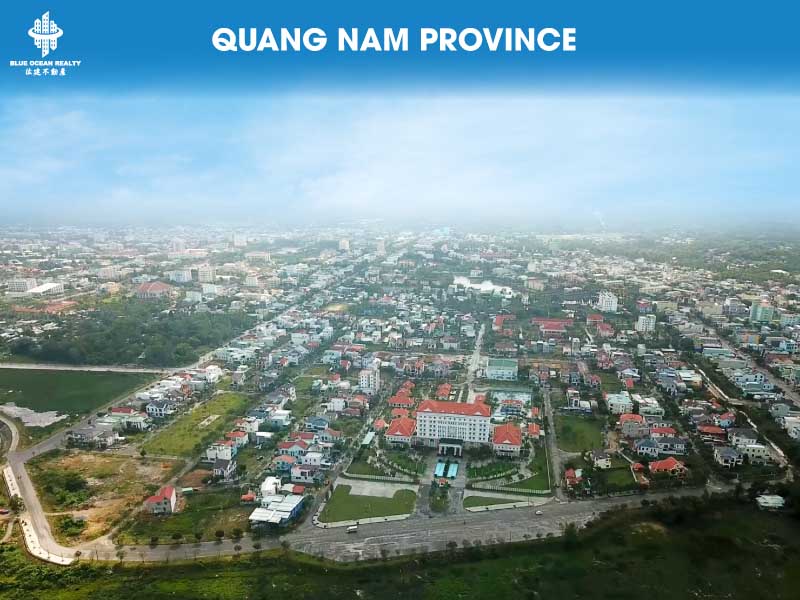
Quang Nam Province Industrial Zone – Investment Overview
INTRODUCTION
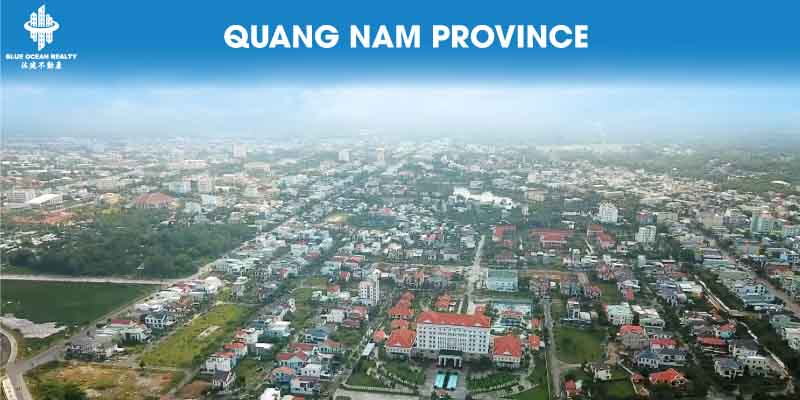
Quang Nam is located in Central Vietnam, part of the country’s key central economic region. It covers a total area of 1,057,474 hectares, comprising nine soil types including coastal sand dunes, river alluvium, marine alluvium, grey degraded soil, red-yellow soil, valley soil, and eroded rocky soil.
Quang Nam enjoys strategic geographical advantages for national and international connectivity and boasts rich natural resources. It is the only province in Vietnam with two UNESCO World Heritage Sites: My Son Sanctuary and Hoi An Ancient Town. It also includes the Cham Island Biosphere Reserve, with pristine natural beauty and rare marine species. With 125 km of pristine coastline and renowned beaches with white sand and golden sunshine recognized by Forbes magazine, Quang Nam is ideal for developing eco-tourism and resort tourism.
The province shares a 157 km border with Laos, positioning it well for economic and cultural exchange domestically and regionally. Quang Nam is recognized for its historical heritage, cultural depth, revolutionary spirit, and iconic landmarks such as the Vietnamese Heroic Mother Monument, modeled after national hero Nguyen Thi Thu. The presence of the pioneering Chu Lai Open Economic Zone, Vietnam’s first coastal multi sector economic zone operating to international standards, further enhances its investment credentials.
GEOGRAPHICAL LOCATION
North: Borders Thua Thien Hue Province and Da Nang City
South: Borders Quang Ngai Province and Kon Tum Province
West: Borders Sekong Province, Laos
East: Adjacent to the East Sea
ADMINISTRATIVE UNITS
As of now, Quang Nam has:
2 cities: Tam Ky and Hoi An
1 town: Dien Ban
15 districts, comprising 241 commune-level subdivisions: 25 wards, 13 townlets, and 203 communes across areas like Tay Giang, Dong Giang, Nam Giang, Phuoc Son, Bac Tra My, Nam Tra My, Hiep Duc, Tien Phuoc, Nong Son, Duy Xuyen, Dai Loc, Thang Binh, Que Son, Nui Thanh, and Phu Ninh.
POPULATION
As of April 1, 2019, 1,495,812 inhabitants
Population density: 149 people/km²
Urban population: 34.3%; rural: 65.7%
Working-age population (15–64 years): 65.4%
Approximately 880,000 workers employed across economic sectors
EDUCATION
As of 2020, Quang Nam has:
3 universities
8 colleges
7 vocational schools
799 schools from preschool to high school (510 national-standard), serving over 349,000 students across 11,000+ classrooms
TOURISM
Known for UNESCO-recognized heritage sites such as Hoi An Ancient Town and My Son Temple Complex, plus historical Cham relics in Tra Kieu, Khuong My, Chien Dan, Bang An towers and Dong Duong Monastery. Its coastline offers renowned beaches—Cua Dai, Bang An, Cham Islands, Ha My, Tam Thanh, Bai Rang—with Cham Islands designated as a UNESCO Biosphere Reserve. Local crafts and ethnic villages (Thanh Ha pottery, Kim Bong carpentry, Tra Que herbs, Triem Tay weaving) enhance eco-cultural tourism. The rich local folk music—ho songs, lyrical verses, proverbs—reflects the cultural charm and identity of Quang Nam.
TRANSPORT INFRASTRUCTURE
Quang Nam is one of the few provinces in Vietnam with an integrated system of airport, seaport, railway, and key highways:
Roads: National Route 1 and the Da Nang–Quang Ngai expressway run through major districts (Nui Thanh, Tam Ky, Phu Ninh, Thang Binh, Que Son, Duy Xuyen, Dien Ban). Complementary provincial and local roads ensure connectivity across plains, hills, and coastal areas. National Routes 14, 14B, and 14E also serve the region.
Railway: The North–South Railway spans approximately 95 km in Quang Nam, with seven stations for passenger and freight service.
Airport: Chu Lai International Airport spans 2,300 ha with two runways, five taxiways, and three apron areas—one of six modern airports in Vietnam.
Waterways: The province has 941 km of rivers (307 km currently managed), including the Thu Bon and Truong Giang systems, which flow into the East Sea via three river mouths: Han River, Cua Dai, and Ky Ha.
Ports: Two ports—Ky Ha Port (up to 20,000 DWT) and Tam Hiep Port (up to 10,000 DWT)—operate with more than 100,000 m² of storage and workshop space. Annual cargo throughputs exceed 1.6 million tonnes, with regular dredging of access channels. Regional ferry routes link coastal towns and islands across Quang Nam and Quang Ngai provinces.
Border Crossings: Laos–Vietnam border gates at Dak Ta Ooc (Nam Giang District) and Ka Lum (Tay Giang District).
ECONOMIC-SOCIAL INFRASTRUCTURE
Quang Nam offers complete utility infrastructure for electricity, water, telecom, wastewater, and solid-waste handling, extended to project boundaries or factory perimeters. Most industrial zones have centralized wastewater and solid waste treatment systems.
Telecommunications: As of Q3/2022, fiber-optic and telecom infrastructure reached 100% of communes (241/241) and 96.5% of hamlets. The province has 1.19 million telephone subscribers (including 26,226 landlines; density 73.8 lines per 100 people) and 159,764 internet subscriptions. Online conferencing is available at 8 central points and every provincial and district administration. Public service portal (LGSP) integrates with national data systems.
Smart Township Applications: All communes are connected with digital infrastructure, public service desks, e government software (Qoffice), and e one door systems.
ECONOMIC PERFORMANCE 2021
Despite challenges from COVID-19, Quang Nam achieved:
GRDP: VND 60,464 billion, growth of 5.04% over 2020
Total economy scale: VND 102,654 billion
Sectoral structure: agriculture 14.08%, industry construction 34.68% (industry 28.37%), services 32.8%, product-tax net 18.45%
Per capita GRDP: VND 67.5 million, growth of 6.63%
Tourism revenue: VND 480 billion ( 55.2%)
Stable agriculture growth: 3.56%
Forest coverage: 59.25%
State budget revenue: VND 23,772 billion (122.85% of plan); domestic revenue 19,560 billion (122.3%); export import revenue 4,124 billion (123.1%)
Trade turnover: USD 3.5 billion (exports USD 1.48B, +40.5%; imports USD 2.01B, +16%)
Public investment disbursement: over VND 5,773 billion (79% of plan)
First 9 months of 2022:
GRDP growth: approximately 13.2%, ranking 8th of 63 provinces and 2nd among Central Vietnam economic hub
GRDP structure: agriculture forestry fisheries 14.9%, industry construction 34.7%, services 32.7%, product tax 17.7%
New business registrations: 999 companies (+10.3% year-on-year), with registered capital VND 6,185 billion
Resumed operations: 505 businesses (+33.6%)
FDI: 4 new projects totaling USD 28.94M; total active FDI: 194 projects worth over USD 6B
Domestic investment: 51 new projects totaling VND 8,369 billion; active domestic projects: 964, totaling VND 242 trillion
Quang Nam Province Industrial Zone – Investment Overview
Over 25 years since re-establishment, Quang Nam has transformed from an agricultural province into a dynamic industrial center in Central Vietnam.
Current Industrial Zone Landscape:
14 industrial zones (IZs), totaling approximately 3,677 ha
10 zones operational; 4 under development
Registered capital: VND 8,925 billion; realized: VND 3,600 billion (40%)
Attracted 225 downstream investment projects: 151 domestic + 74 FDI; total registered capital VND 78,446 billion
In 2021, IZs delivered export turnover of USD 1.056B, import turnover USD 1.8B, and stable jobs for 55,000 local workers
Industrial zones have upgraded Quang Nam’s economic structure and output quality, deploying modern technology and advanced machinery to raise competitiveness and production value.
Future Planning:
The Chu Lai Economic Zone is positioned as the sector’s core driver
Quang Nam plans new industrial zones: Nam Thang Binh (449.43 ha), Bac Thang Binh (239 ha), Phu Xuan (108 ha)
Additional 4,000 ha allocated along Vo Chi Cong Road, Da Nang–Quang Ngai Expressway, National Routes 14D, 14E
By 2035: 93 industrial clusters (total 2,759 ha) planned
In 2021, among 55 focused clusters, 179 investment projects underway, valorizing over VND 6,382 billion and employing 29,718 locally
development target
By 2030, Quang Nam aims to join Vietnam’s ranks of well-developed provinces; by 2050, to become a modern, comprehensive province, with most citizens belonging to the middle and upper social class.
Projected growth:
Average GRDP growth: 9.3% (2021–2030), 8.30% (2021–2025), 10.25% (2026–2030)
Per capita GRDP by 2030: VND 195.2 million (~USD 7,690)
Economic structure by 2030: agriculture forestry fisheries 9.9%, industry construction 36.2%, services 34.4%
Learn more about us:
—
Your trusted partner in Vietnam Real Estate, Industrial Parks, and Invest Vietnam.
Stay Connected:
- Fanpage: blueoceanrealtyvn
- Youtube: BlueOceanRealty , @batdongsanbor , @blueoceanrealtyvietnam
- Instagram: blueoceanrealtyvn
- Tiktok: @bortintuc
Hotline/ Zalo: +84888089696
—